

NEWS
For companies choosing between glass and plastic packaging, the real question is rarely “Which one is better?” It is “Which one fits the product, the channel, and the brand promise with the fewest trade-offs?” In kitchenware and food-adjacent categories, glass mason jars often make more sense than plastic containers when the contents are sensitive, the shelf presentation matters, or the packaging itself becomes part of the customer experience.
That does not mean glass is the universal winner. It is heavier, more fragile, and usually less forgiving in freight and handling. But there are specific situations where those disadvantages are outweighed by better product protection, stronger consumer confidence, and a more premium positioning. If the decision is being made at a business level—not just a procurement level—that distinction matters.
Where glass starts to outperform plastic
Glass mason jars become the stronger choice when packaging needs to do more than contain. In many kitchen-related categories, the container is visible on a counter, in a pantry, or at the dining table. That changes the economics. A package that looks durable, clean, and reusable can support higher perceived value in a way low-cost plastic often cannot.
This is especially true for products such as dry ingredients, spice blends, infused syrups, preserves, meal-prep components, drink concentrates, fermentation starters, and giftable food items. If customers are likely to keep the package after first use, glass has a practical second life. That reduces the feeling of waste and can quietly improve how the brand is remembered.
Plastic containers still dominate where impact resistance, light weight, and low unit cost are the main drivers. But in premium retail, specialty foods, home organization, and refill-oriented concepts, glass mason jars often move from “nice-looking option” to commercially rational option.
When product compatibility is the deciding factor
One of the most practical reasons to choose glass is chemical stability. Glass is generally non-reactive, which matters when the contents are acidic, aromatic, oily, or intended for longer storage. Think tomato-based sauces, vinegar preparations, fruit preserves, pickled vegetables, herb oils, or strong spice blends. In those applications, packaging is not just about leakage or breakage. It is about whether flavor, aroma, and product integrity stay where they should.
With plastic, suitability depends heavily on resin type, wall thickness, closure compatibility, fill temperature, and storage conditions. Many plastics perform very well when properly specified. The issue is that “plastic” is not one material in practical terms. Procurement teams sometimes compare glass against plastic as if the plastic option were simple and fixed. It usually is not. If the product has oils, acids, essential aromas, or hot-fill requirements, validation work tends to become more demanding.
Glass simplifies part of that discussion. It does not solve every packaging problem, but it removes a layer of concern around interaction between product and container. That can be valuable when quality complaints would be costly or hard to reverse.
Premium perception is not a cosmetic issue
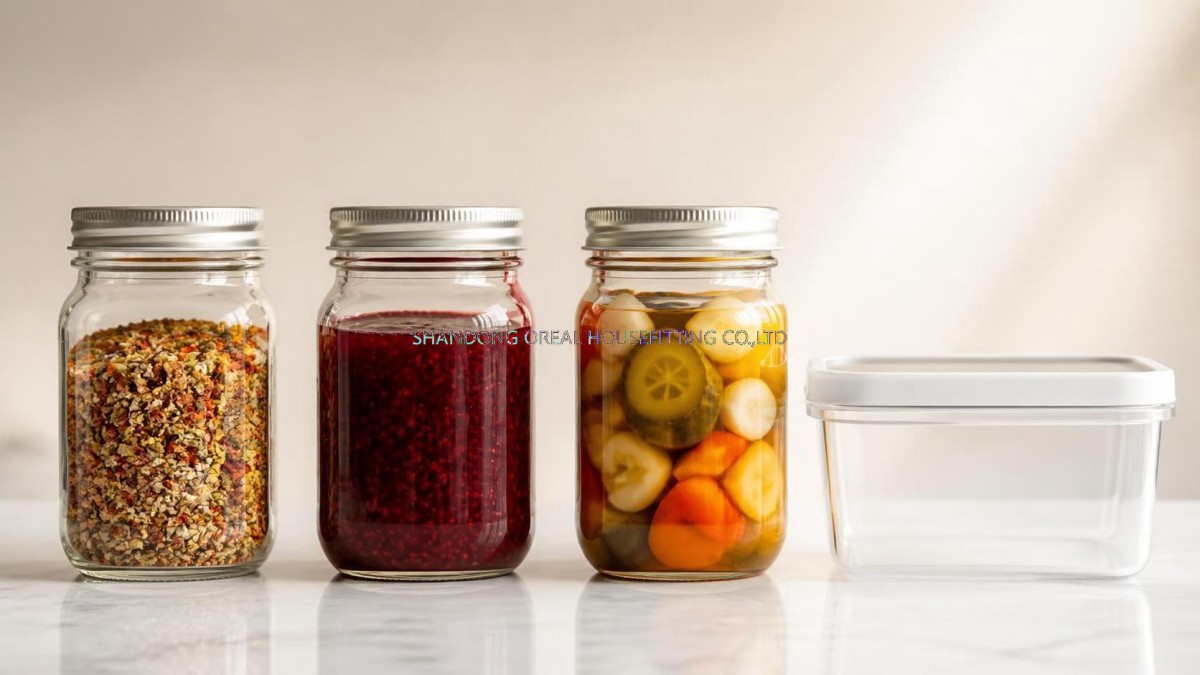
Decision-makers sometimes treat appearance as a marketing preference and durability as an operations concern, as if the two were separate. In reality, packaging format can influence velocity, margin, and return risk at the same time. Glass mason jars communicate transparency—literally and commercially. Buyers can see texture, color, inclusions, layers, sediment, or fill level without the slight haze that some plastics develop over time.
That visibility matters more than it sounds. For products sold on taste, craftsmanship, freshness, or handmade positioning, a clear glass wall is doing selling work. If your product is visually appealing, hiding it inside an ordinary plastic tub often gives away part of the premium before the customer even evaluates the contents.
This is where glass mason jars are often a better packaging choice than plastic containers: when shelf impact and perceived trust are tied directly to purchase behavior. Not every category benefits equally, but artisanal, small-batch, gift-oriented, and home-use kitchen products usually do.
Heat, filling method, and process realities
Operations teams usually raise the right objection early: glass may look better, but can it run efficiently through the existing line? That is the correct question. Packaging decisions should not be made from a mood board.
Glass mason jars tend to be a better fit when the process involves hot filling, thermal stability, or products that may be reheated or reused by consumers after purchase. Depending on the exact jar specification and closure system, glass can support applications where some plastic formats would need tighter process control or a different material grade.
That said, the jar itself is only part of the system. Closure performance, vacuum requirements, torque consistency, and transport packaging all matter. A common mistake is to compare a glass jar to a plastic container at unit level only. The better comparison is line compatibility plus total damage risk plus customer use case. In some facilities, the line is already set up in a way that makes glass practical. In others, the secondary packaging needed to protect glass may erase the advantage.
So if hot or warm fill is one of the reasons glass is under consideration, it is worth reviewing the full packaging workflow, not just the material spec.
Sustainability claims are only useful when they survive scrutiny
Glass is often chosen because it feels like the more responsible material. Sometimes that is true in market perception, and sometimes it aligns with actual waste handling advantages. Glass is widely recognized as recyclable in many regions, and consumers often understand what to do with it. That familiarity can make communication easier than with plastic formats that depend on local recycling capabilities or more nuanced disposal rules.
Still, sustainability should be handled carefully. Heavier packaging may increase transport emissions. Breakage can increase waste. A beautifully recyclable jar is not automatically the lower-impact choice if the supply chain is long, the protection materials are excessive, or the item is primarily sold through parcel networks with high damage exposure.
Where glass mason jars tend to make stronger sense is in shorter distribution loops, premium retail, refill systems, local food programs, and categories where reuse is realistic rather than theoretical. If customers actually keep the jar for pantry storage, leftovers, or household use, the packaging has a practical afterlife. That is a more credible story than generic environmental messaging.
The shipping question that usually decides the outcome
Many packaging decisions are won or lost in freight, not in branding workshops. Glass costs more to move. It needs better dividers, stronger outer cartons, and more attention in warehousing. If your business model depends on low-cost parcel fulfillment, high shipment density, or long export routes with multiple handling points, plastic often keeps the operational edge.
But there is a less obvious side to this. If the product is positioned as premium, margins may absorb the higher packaging and transport cost more effectively than teams assume—especially if glass reduces returns related to leakage, odor retention, staining, or consumer disappointment with appearance. The math is rarely just freight per unit. It is total delivered cost plus how packaging affects conversion, price tolerance, and complaint rates.
For store-based distribution, gift retail, subscription boxes with curated presentation, or local delivery models, glass can still be commercially sensible. For high-volume e-commerce of lower-priced goods, it often becomes harder to justify unless the brand identity depends on it.
A practical comparison
Common mistakes in the glass-versus-plastic decision
One mistake is assuming that a lower container price means a lower packaging cost. It may not, once labeling performance, closure fit, consumer complaints, and secondary packaging are included.
Another is treating all glass mason jars as interchangeable. Neck finish, wall consistency, closure compatibility, and dimensional tolerance all affect filling and sealing. The familiar shape does not guarantee identical performance.
There is also the reverse error: choosing glass for image reasons without stress-testing shipping conditions. If the damage rate is likely to be high, the brand message will not survive the first wave of broken deliveries.
And one more point that often gets overlooked in kitchen-related categories: ergonomics. A jar that looks excellent on shelf but feels awkward in the hand, too heavy for repeated use, or difficult to dispense from can create friction in everyday use. Packaging should work in the pantry, at the sink, on the counter, and in storage—not only in product photography.
How to decide without overcomplicating it
If the product is premium, visible, sensitive, or likely to be reused by the customer, glass deserves serious consideration. If the product is cost-driven, widely shipped, impact-exposed, or operationally constrained, plastic may remain the more practical answer.
In many real projects, the best route is not a blanket material preference but a channel-based decision. A company may use glass mason jars for specialty retail, gift sets, or flagship SKUs, while keeping plastic for value lines or high-risk e-commerce distribution. That kind of split strategy often reflects how packaging decisions actually get made when margin, logistics, and brand positioning all have a vote.
So when are glass mason jars a better packaging choice than plastic containers? Usually when the package needs to protect product quality, reinforce trust, and stay useful after purchase—and when the supply chain can support the extra care glass requires. If those conditions are present, glass is not just a stylistic upgrade. It is often the more coherent business decision.
Leave a Message
Leave a Message Online